
(And what costs do you overlook with a traditional lease?)
“Cash is king,” says entrepreneur and author Richard Branson. And that’s exactly why the question isn’t just how much your office costs, but above all, how predictable those costs are if you want to get your numbers in order this fall.
In 2026, many teams are finding that office budgets are shifting more rapidly than in the past: cost-of-living adjustments continue, energy rates remain volatile, and contract renewals often come with new “fine print.” Anyone who is now tightening their office budget for Q4 while already thinking about planning for 2027 wants one thing above all else: no surprises on the invoice.
“All-in” in 2026 is more than just a marketing term.
What we mean is: one payment per month, and that's it. In practice, it comes down to two questions:
– What costs are actually included in the monthly fee?
-How much flexibility do we have?
With traditional leases, you often pay a base price that seems attractive at first glance, but it is later supplemented by advance payments, final settlements, additional contracts with suppliers, and periodic maintenance bills.
An all-inclusive package works the other way around: you start with a workspace that’s “ready to go,” complete with services and amenities that you would otherwise have to organize one by one.
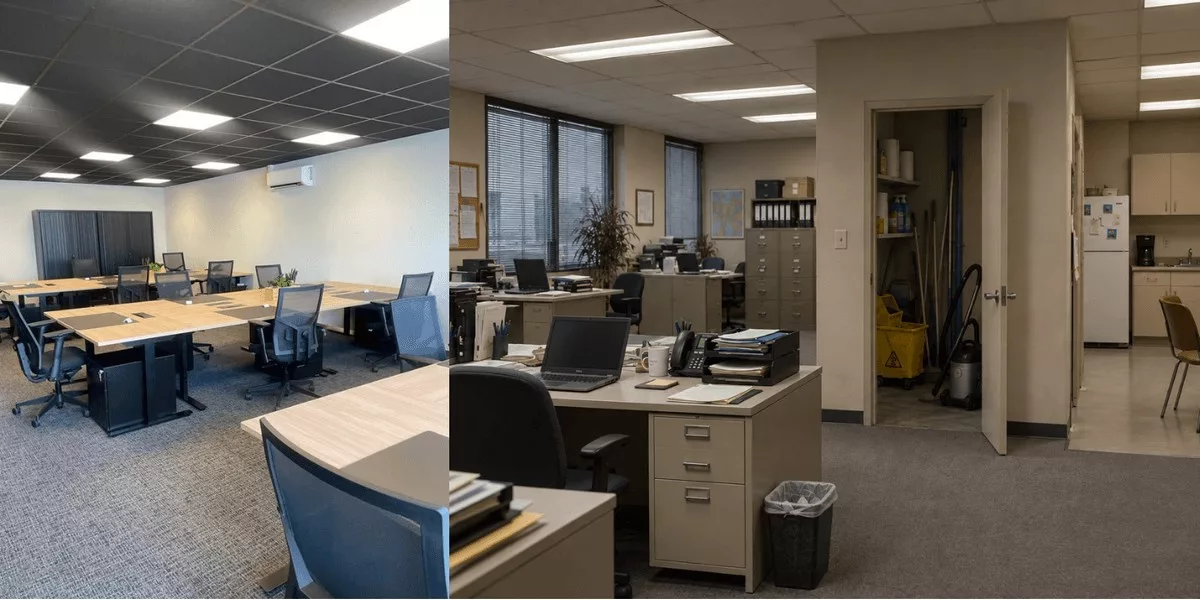
Officenter It doesn't base its offerings on square meters, but on complete, move-in-ready workspaces. You choose a package, your team can move right in, and you don't waste weeks on IT, hookups, cleaning schedules, or reception arrangements.
The biggest pitfall of a traditional lease agreement isn't the rent itself, but the additional costs associated with it. These are expenses that are still often underestimated in 2026.
Utilities
Electricity, water, heating, and cooling seem “manageable” until you have to forecast them. Especially with fluctuating occupancy, hybrid work, and additional server or charging needs, office utility costs can quickly add up.
Fixed connection fees and utility charges: peak consumption from air conditioning or heating during the off-season, the difference between advance payments and final bills, …
Internet and telephony: Internet is rarely as simple as “signing up for a subscription.” You’ll have to deal with installation, SLAs, internal Wi-Fi coverage, cabling, devices, and sometimes even separate contracts for VoIP.
In a plug-and-play environment, that’s exactly the point: you don’t have to negotiate with three different parties before you can work reliably on day one.
Cleaning, maintenance, and minor repairs: these are classic hidden costs. You don’t just pay for the cleaning service, but also for: consumables and restocking, extra cleaning sessions after events or busy periods, minor repairs (doors, locks, lighting, plumbing), periodic maintenance of systems, …
Anyone who’s ever had a debate over “who pays for the repair?” knows how quickly this can eat up time and money.
Property tax and municipal fees
In some contracts, these are passed on to the tenant; in others, they’re hidden in the general expenses. This makes it difficult to compare, because you’re comparing a “base” rent to a total cost that hasn’t been calculated yet.
Insurance and Liability
Consider building insurance, glass breakage coverage, liability coverage for common areas, and sometimes additional coverage requirements imposed by the landlord.
With any plan—whether classic or all-inclusive—it’s a good idea to have a clear list of what’s included and what’s not. “Use of” doesn’t always mean “included in the price.”
The difference lies in predictability. It's all about control.
With an all-inclusive workspace solution, you have a single, clear monthly cost, which makes budgeting easier.
For business owners who want to keep their cash flow tight in Q4, this is often the deciding factor.
A single fixed monthly fee that covers all the costs of a ready-to-use workspace, such as utilities, internet, cleaning, and maintenance, with no additional invoices.
Utilities such as electricity, water, and heating; Internet and telephone services; cleaning and minor repairs; property tax; municipal taxes; and insurance.
That varies by contract: sometimes it’s billed separately, and sometimes it’s included in the general expenses. That’s why it’s important to always have a clear breakdown of what is and isn’t included.
With Officenter , this is all taken care of. This means there’s no need for separate negotiations with a provider, installer, or phone service provider, unlike with a traditional lease agreement.
Because you have a single, predictable monthly cost instead of a base price that is later supplemented by advance payments, final settlements, and unexpected invoices.
Not necessarily. The comparison is often flawed because a “base” rent is being compared to a total price that already includes additional costs.
Officenter updated its plans and rates. Find out which Workspace is right Workspace you
